Last updated on November 17, 2024
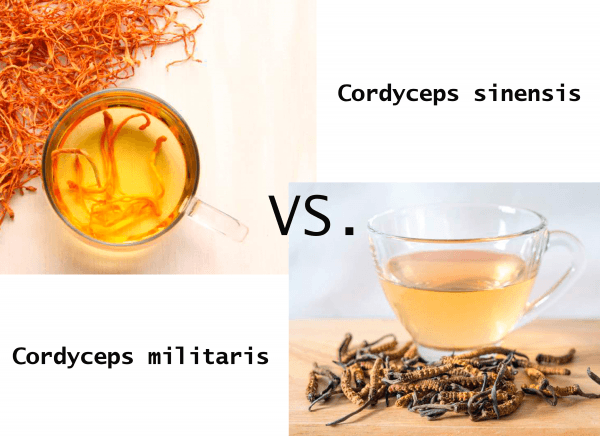
With the launch of our higher quality mushroom line comes some questions. One such question is what is the difference between Cordyceps militaris and the traditional Cordyceps sinensis, which we used to sell and is commonly sold in stores and marketed online?
These are two distinct species, with one being studied a bit more than the other for health benefits at this time. That being said, there is very little out there to confirm or deny that they both do the same thing endurance wise.
About Cordyceps sinensis
Sinensis description is as follows:
Parasitizes larvae of ghost moths, sinensis consists of two parts, a fungal endosclerotium (caterpillar) and stroma. The stroma is the upper fungal part and is dark brown or black, but can be a yellow color when fresh and, longer than the caterpillar itself, usually 4–10 cm. It grows singly from the larval head and is clavate, sublanceolate or fusiform and distinct from the stipe. The stipe is slender, glabrous, and longitudinally furrowed or ridged. [1]
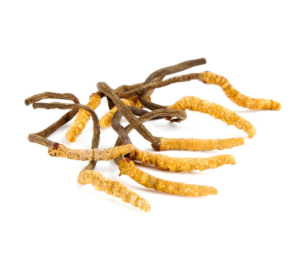
Actually, the technical name for what was Cordyceps sinensis is now Ophiocordyceps sinensis. This change in the Genus is just one example of the confusion surrounding the use of Cordyceps. More recent research is showing that there are several symbiotic species living together. That the common CS-4 strain is actually Paecilomyces hepiali and not Cordyceps sinensis. [2]
About Cordyceps militaris
Militaris is described as:
Parasitic on buried larvae and pupae of insects (primarily moths and butterflies); growing alone or gregariously.2-8 cm long; up to about .5 cm wide; club-shaped, with the top wider than the base; the upper portion orange and pimply, the lower portion smooth and orange to pale orange, often curved; narrowing at the base and arising from the buried pupa or larva; flesh pale watery orange, with an outer cortex. [3]
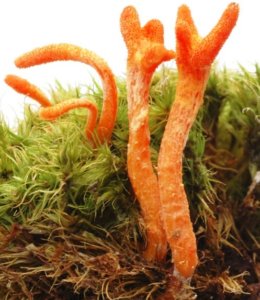
This video shows militaries grown on a specially prepared rice substrate:

Both fungi look different which means they are made up of different components. Not surprisingly though, the same benefits that are oft touted in Traditional Chinese Medicine for sinensis and that research has been showing to be largely factual, is found in both mushroom species.
What do Studies say about Cordyceps militaris vs. Sinensis?
Both have the same bio-active compounds as each other and Cordyceps militaris has been shown to possess even higher amounts of some than that of C. sinensis.
A study titled, Chemical Composition and Nutritional and Medicinal Value of Fruit Bodies and Submerged Cultured Mycelia of Culinary-Medicinal Higher Basidiomycetes Mushrooms, was published in June 2014.[4]
It found that militaries and sinensis of all mushrooms tested in the study possessed the highest amino acids (some of the others that were tested were Lion’s Mane, Turkey Tail, Reishi, Shaggy Ink Cap, Shiitake, and Oyster).
Bioactive components “were lovastatin, GABA, and ergothioneine, which are commonly found in most mushrooms. C. militaris (FB), Pleurotus ostreatus (FB), and Coprinus comatus (FB) were most abundant and contained a high amount of GABA and ergothioneine…In contrast to C. militaris (FB), cordycepin was not detected in O. sinensis (MB). The fruit body biomass of C. militaris cordycepin content reached 1.743 mg/g dry weight.”
I should note that FB stands for fruiting bodies and MB stands for mycelium bodies.
This is really important because Cordycepin, a main active ingredient in all cordyceps species was NOT found in the MB version of sinensis.
Does Cordyceps sinensis have more cordycepin in nature than that of militaris?
No one knows yet but I believe it will prove to be true. However, as over-harvesting of Tibetan Cordyceps has made it an endangered commodity, not to mention really, really expensive, Cordyceps militaris is a much more sustainable variety for getting this compound in the diet.
More research on militaris will be coming out in the future because of this. Already it has been used to create synthetic cordycepin that is being studied by the pharmaceutical industry in phase 1 trails for leukemia among other things.
You can read more about Cordycepin in this article.
Probably the biggest thing athletes might want to know about is the endurance factor. Militaris has been shown to have an anti-fatigue effect just like its cousin in Tibet. Animal studies, though not the best, have shown that both increase ATP, antioxidant activity and enhance lactate removal from muscles. [5][6]

The largest difference between the two at this point is since we all cannot be eating wild Tibetan Cordyceps, perhaps it doesn’t matter what species you are consuming. As long as it is of a quality source that is sustainable and processed well, just eat more mushrooms regularly.
How our Cordyceps militaris extract powder is made?
Many mushroom products on the market, including most “Cordyceps”, are mycelium grown on grain. That means that most of what is in the product is mycelium. I’m not saying this doesn’t have benefits, but research is showing it’s not as much as the mushrooms or fruiting bodies themselves. You can read more in this article: Most Mushroom Products Aren’t What They Claim
We used to sell this Cordyceps sinensis powder but stopped when we realized it was mycelium grown on grain exclusively.
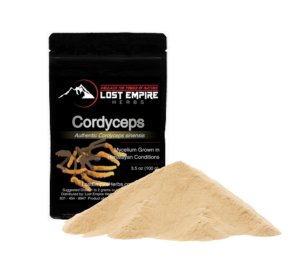
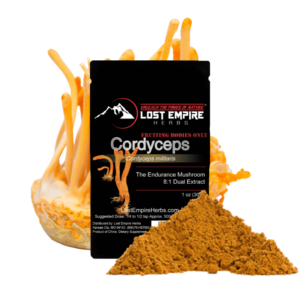
Meanwhile, our Cordyceps militaris is purely fruiting bodies. Though it is grown on mycelium, unlike our other medicinal mushroom products, it’s just the fruiting bodies and nothing else. In addition, they are 100% organically grown, produced in a state of the art facility in China.
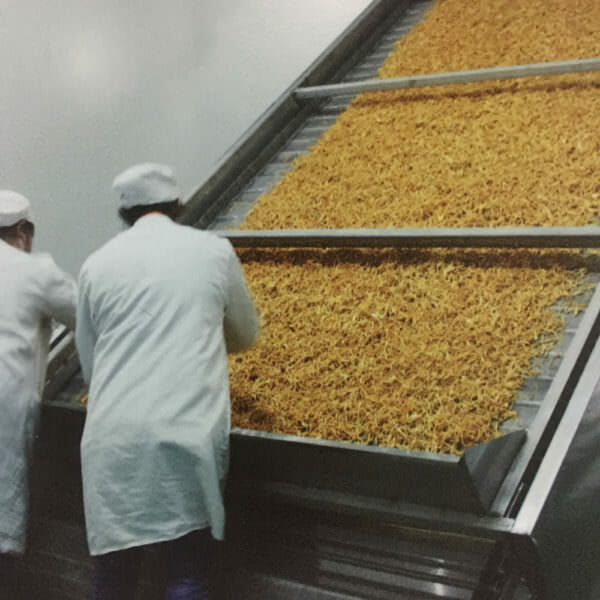
These are then dual extracted in a ratio of 8:1 with alcohol and hot water and dried to form this powdered extract.
Related Articles:
- Amazing Paul Stamets Interview about All Kinds of Mushrooms
- Most Mushroom Products Aren’t What They Claim
- Herbs for Athleticism
References:
- Ophiocordyceps sinensis on Wikipedia
- Alfred Chioza and Shoji Ohga. A Review on Fungal Isolates Reported as Anamorphs of Ophiocordyceps sinensis. Journal of Mycology. Volume 2014, Article ID 913917.
- Cordyceps militaris
- Nachshol C., Jacob C., Mikheil D. A., Vinay K. V., Hui-Tzu Y., Yi-Chi Y., Yu-Hsuan L., Jeng-Leun M., Solomon P. W. (2014). Chemical Composition and Nutritional and Medicinal Value of Fruit Bodies and Submerged Cultured Mycelia of Culinary-Medicinal Higher Basidiomycetes Mushrooms. Int J Med Mushrooms. 2014;16(3):273-91.
- Jingjing S., Yingwu W., Meiyu T., Guangsheng C., Hongkai X., Hanxiao G., Yang L., Di W., and Lesheng T. (2015). Studies on the Antifatigue Activities of Cordyceps militaris Fruit Body Extract in Mouse Model.
- Ashok K. P. and Kailash C. S. (2011). Traditional Uses and Medicinal Potential of Cordyceps sinensis in Sikkim. J Ayurveda Integr Med. 2011 Jan-Mar; 2(1): 9–13.

I purchased cordyceps sinensis extract from bulk supplements. The label says cordyceps extract 1500mg dose. Under that in () says :
(Cordyceps sinensis) then:
(Sporocarp)
Standardized to contain ≈ 20% Polysaccharides
Directions are to take 1500mg once or twice daily or as directed by physician.
Does anyone happen to know anything about the species and strain I have? Does it even contain an active level of cordyceptin?
Thanks
Had to look this up. “In fungi, the sporocarp is a multicellular structure on which spore-producing structures, such as basidia or asci, are born.” Never seen that before on a label. So it should be the sinensis version. You’d have to ask them regarding cordyceptin or the other compounds though.
On your page about Cordyceps militaris you more or less state that CS-4 is not even Cordyceps, suggesting it’s best avoided.
First of all, this is factually untrue. CS-4 is a so called ‘anamorph’ and these have their own names (I think that is slowly changing now because it causes confusion).
Second, almost all research was done with CS-4 (and pretty good results, so I would still choose CS-4 over the so-called ‘real’ Cordyceps) CS-4 was found to be more potent than wild Cordyceps, actually.
It sounds like you are quoting the marketing people at Aloha Medicinals who are making similar claims, while selling a product that is not even extracted (undigestible) and contains 30% starch (because it is based on biomass, not mycelium).
That aside, Cordyceps militaris is the way to go if you are after cordycepin, which is THE main bioactive compound.
Not all the research is done with CS-4. The issue is there doesn’t seem to be any solid research comparing the differences between the versions. And if you say more potent, the question is in what way really. Likely each is better for certain things, but not necessarily others. Advantages and drawbacks to everything.
Our cordyceps militaris IS extracted, so not sure where you picked up the idea that it wasn’t.
Hi, I am trying to grow Cordycep militaris on larvae (silkworm pupa) with high cordycepin. Can you help me? Where can i get it?. many thanks
Sorry, growing the stuff ourselves is not something we’re experienced in yet.
I think difficult to growing cordyceps sinensis beacause it only grown on larvae. This larvae have cycle verry verry long, near one year. If you grown, you prepare 2 part, fist is larvae and second fungal.
Hi, I am trying to grow sisensis on larvae. Can you please help me get the mycelium. Where can I get it?
You might check with aloha medicinals. Not sure if they grow it but if they do they will probably get you spores or at least know where to go for it.
Why Larvae? No one grows it on larvae at this point. Why? To limit the transfer of unknown toxins from said larvae. This is why Paul Stamets grows his larvae on plant matter and nammex does the same. Growing your product on larvae doesn’t create a more potent end product.
You don’t know that. All fungi concentrate components from within their growing medium. This is why tree grown mushrooms tend to be better than grain. Thus, it makes sense that if the actual insect were used it would likely be better. BUT this hasn’t been studied, and logistically isn’t likely to happen for any commercial supplement.
Hello, just to follow up that Mark doesn’t know what he’s talking about, in Traditional Chinese medicine the same cordyceps when grown on cicadas (chan hua) is used to clear irritation from the sensory orifices and has quite a different set of therapeutic functions. I’ve seen it currently used in a formula for visual problems by Subhuti Dharmananda, (itmonline.org), you can reach out to him for more info.
So, yes, the empirical data accumulated in TCM points to the medium in which the cordyceps is grown making a difference. How could it not, really?