Last updated on June 17, 2025
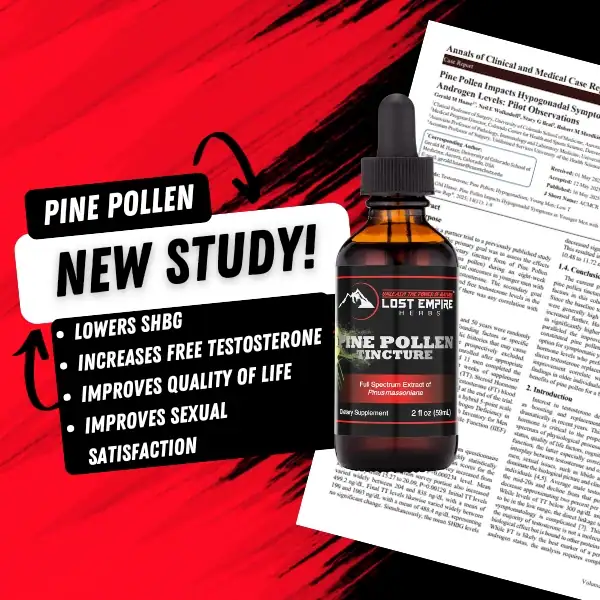
With testosterone levels plummeting in modern men, the race is on for safe, natural solutions. Our latest research on Pine Pollen Tincture gives us a fundamental shift in how we may think about Pine Pollen by focusing it on free testosterone.
Lost Empire Herbs was happy to fund the first-ever Pine Pollen testosterone study to be done. This took place last year and is covered in full detail in a previous post.
Shortly after that was finished, we talked to the researchers about next steps. They suggested aiming for a younger group of men. In addition, we tested an additional element of sex or steroid hormone binding globulin (SHBG). In combination with total testosterone, this would allow us to look at free testosterone levels.
The standard way of thinking about SHBG is that it binds to testosterone (as well as some other hormones) and renders them inert. This leads to the difference between total and free testosterone. It is a compound in the body that tends to increase with age.
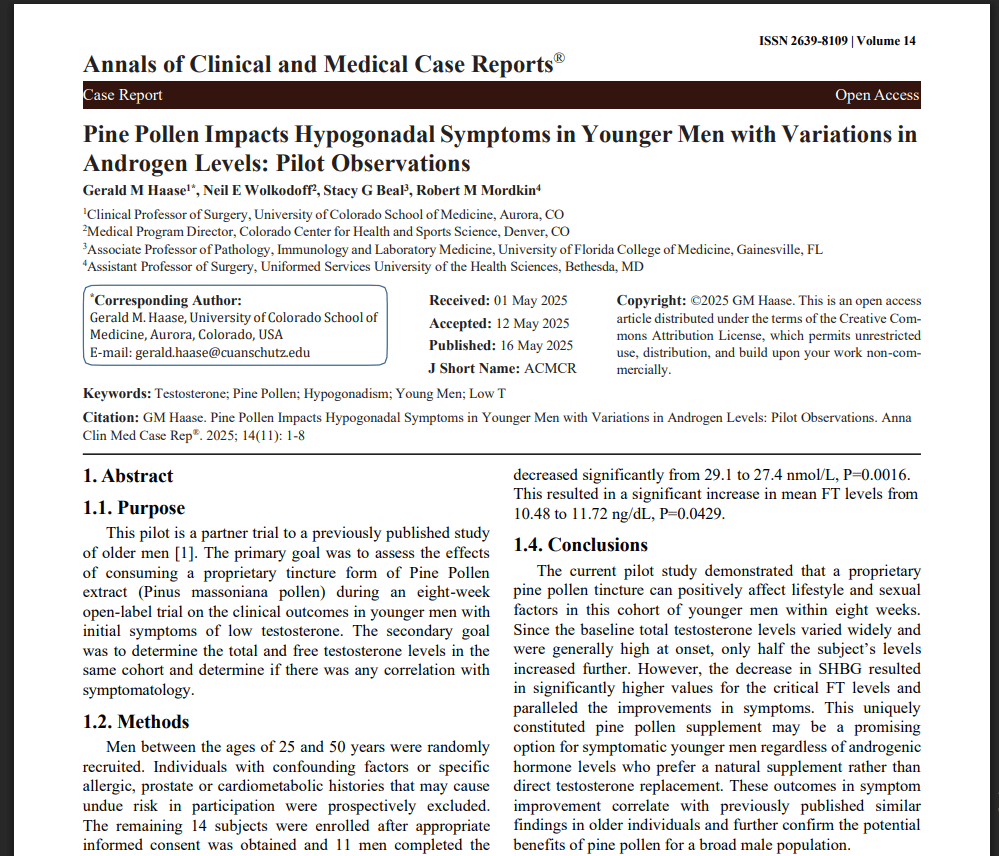
This was published in the middle of May 2025 in the Annals of Clinical and Medical Case Reports, which you can view here:
In this article, I’ll discuss the results, what it means for you, the limitations of the study, and all of that.

The Purpose
“The primary goal was to assess the effects of consuming a proprietary tincture form of Pine Pollen extract (Pinus massoniana pollen) during an eight-week open-label trial on the clinical outcomes in younger men with initial symptoms of low testosterone. The secondary goal was to determine the total and free testosterone levels in the same cohort and determine if there was any correlation with symptomatology.”
As mentioned, we didn’t just want to do the same thing as before. With science being as expensive as it is, this had to be worth it in some sense of the word.
While older subjects were a natural place to start in the first trial, here we went a bit more difficult in working with younger men. That’s because it was feasible that maybe the effects wouldn’t be as strong in them.
Research points to free testosterone being more important than total testosterone. So, by not just getting total testosterone, but also SHBG levels, this time, we would be able to calculate free testosterone.
The Subjects
- Men aged 25 to 50 were enrolled. (Mean age 40.15 years old)
- Men with confounding issues, such as prostate issues, were removed.
- 14 subjects started, with 11 of them completing the trial. (That drop off is quite normal with science as life happens, two for non-compliance and another for a non-related illness that stopped his participation in the trial.)
- They had to have at least three of the listed symptoms commonly associated with low testosterone, including “low libido in terms of sexual interest and erectile function, low life enjoyment, poor energy and increased fatigue, as well as mood and emotional dysfunction.”
The Protocol
The trial was for 8 weeks. This involved using the exact same tincture we sell, our Pine Pollen Tincture, at the recommended dose of 1 mL, twice per day, morning and evening. It was cycled for five days on and two days off.
Before starting and then after the 8 weeks, the participants completed the questionnaire and took an at-home blood sample.
Lifestyle, nutrition, supplements, and medications were to remain consistent throughout the 8-week period, beside the Pine Pollen Tincture to help isolate this as the variable.
It’s great to be able to say that our tincture, dose, and cycling method are now all scientifically vetted.
The Quality of Life and Sexual Function Survey
The initial trial used just one survey exclusively, the qADAM. For this trial, some changes were made by combining parts of three different scientifically used surveys.
- qualitative Androgen Deficiency in the Aging Male (qADAM)
- Sexual Health Inventory for Men (SHIM)
- International Index of Erectile Function (IIEF)
Although the qADAM touches on sexual health and performance, the latter two focus more so on this area. By focusing on sexual function, there was more data focused on this area of erectile performance, specifically which many people use Pine Pollen for.
The combined or hybrid survey looked like this:
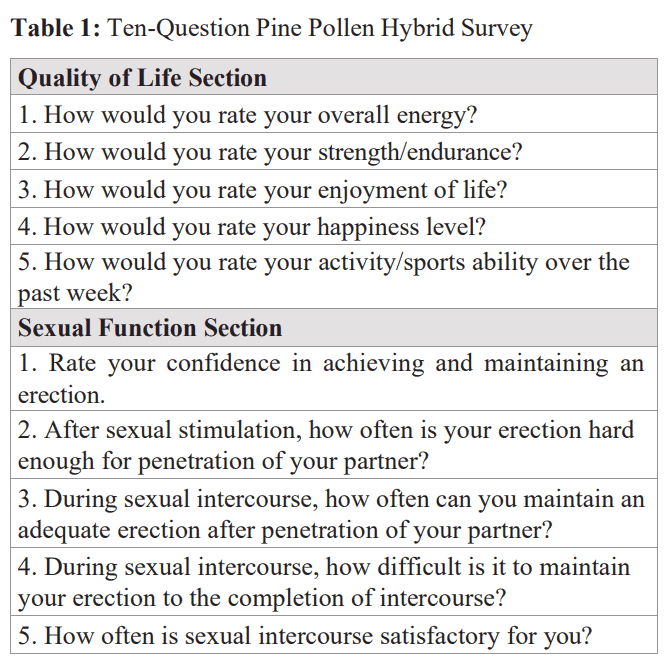
Each of these questions would be answered on a scale of 1 to 5.
- For the QOL [quality of life] section, the number “1” was denoted as “terrible,” and equated to a rating of “very dissatisfied”, while the number “5” was denoted as “excellent” and equated to a rating of “very satisfied.”
- A similar rating scale was used for the sexual function section, except that these questions generally rated “frequency” or “difficulty” on the “1” to “5” scale.
The total score would thus be from 10 to 50, with 30 being an average rating.
48.6% Improvement in Quality of Life and 31.6% Increase in Sexual Performance and Satisfaction
As we saw in the previous trial, the men went from below average to above average over the 8 weeks based on the answers to the questions.
- The initial scores for the quality of life questions ranged from 9 to 19 (mean 13.09).
- The final scores for this section ranged from 9 to 24 (mean 19.45, P=0.000234).
- All but one subject considered themselves “above average” at study completion.
- The initial scores for the sexual function questions ranged from 8 to 19 (mean 15.27).
- The final scores ranged from 8 to 25 (mean 20.09, P=0.00129).
- The number of subjects who considered themselves “above average” (above 15) increased from six to ten at study completion.
- The mean composite outcome level for the survey increased from 28.36 to 39.55 and was highly statistically significant with a t-test value of P=0.000717 as seen here.
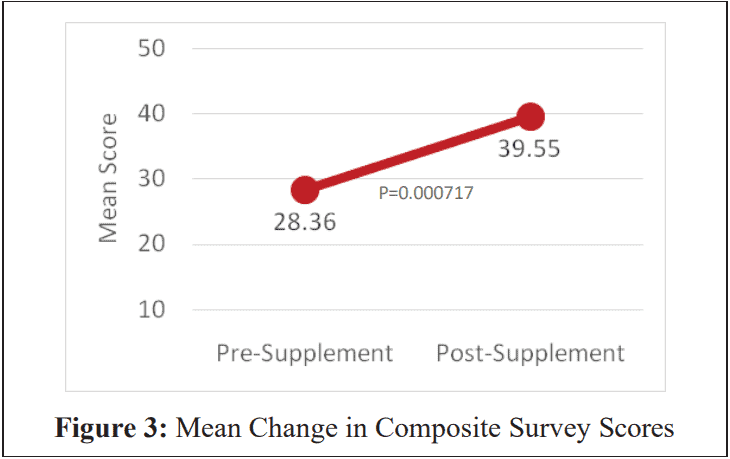
When calculated out, this means that the tincture led to a 48.6% improvement in quality of life responses. Not quite as high, but still amazing, a 31.6% increase in sexual performance and satisfaction as rated by the responses.
No Significant Change to Total Testosterone
Not everything came out perfectly as we would have loved to have seen in this trial. While our initial trial saw an increase in total testosterone, just below standard statistical significance, this one did not. It was likely because of the larger range of values, in addition to this being younger men.
For total testosterone levels:
- Baseline: 229 to 838 ng/dL (mean 499.2 ng/dL)
- Final: 190 to 1003 ng/dL (mean 488.4 ng/dL)
Total testosterone went up in some and down in others, though with an overall slight decrease of a negligible 11.8 points. There was no significant difference, meaning this was more than not likely just due to chance (P=0.7663).
That’s the bad news. But truthfully, what else happened was vastly more interesting…
Pine Pollen Tincture Led to 6% Decrease in SHBG and 12% Increase in Free Testosterone
The reason why this is so fascinating is that this is, mechanistically, more likely to be what Pine Pollen (especially in the tincture format) does in the human body. It frees up testosterone that is already present.
For SHBG levels:
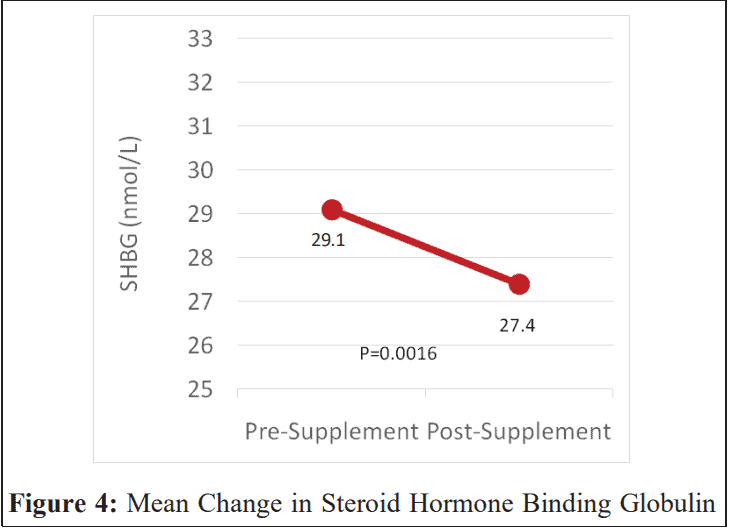
- Baseline: 9.28 to 61.4 nmol/L (mean 29.1 nmol/L)
- Final: 8.59 to 58.8 nmol/L (mean 27.4 nmol/L)
- Improvement: 1.7 nmol/L or 6% decrease
- Statistically significant: (P=0.0016)
For free testosterone levels:
- Baseline: 4.4 to 14.8 ng/dL (mean 10.48 ng/dL)
- Final: 7.7 to 16.6 ng/dL (mean 11.72 ng/dL)
- Improvement: 1.24 ng/dL or 12%
- Statistically significant: (P=0.0427)
12% more free testosterone doesn’t just sound good on paper—it’s the kind of boost that will lead to better energy, stronger libido, and improved drive, as the survey results found.
The Limitations of this Study
This was not double-blind or placebo-controlled, which are needed for the gold standard of research. Instead, it was a pilot trial, with just 11 subjects completing it.
One of the subjects saw decreases in both total and free testosterone. This probably wasn’t from the tincture itself, but some other life events. That being said, it is why we are always saying that nothing works for everyone. Even with the scientific proof, that just speaks to averages, not to every single individual.
Knowing the difficulties in science, I’ll also state that Lost Empire Herbs simply funding the study is likely to lead to research that is positive. Besides initial consultations, I, nor anyone else in Lost Empire Herbs, did not take part in the subject selection, follow-up, data analysis, or writing of the study at all.
Such private funding is often needed in researching herbs because of the dominant medical model not wanting to find such natural answers. So, although it isn’t a perfect system, it’s what we have to work with.
Wrapping Up, Plus Future Research
The first study was exciting because it was the first to look at humans and hormone levels with Pine Pollen. It gave us some initial data to work with beyond just the scores of anecdotal evidence we had.
Because of that study, we decided on the parameters of this study, which was to work with younger men, look at SHBG, and thus free testosterone in addition to total testosterone. In addition, there was the expansion of surveying to pinpoint an area of benefit for this herb around sexual health particularly.
Based on the results, I can say those were some good choices. Imagine if we had stopped at total testosterone, without looking at SHBG, for this study. With no change in total testosterone, the results would have been underwhelming. Instead, we’ve built the stepping stone for understanding better how phytoandrogens work.
Had that initial study looked at SHBG, we more than likely would have seen decreases there (perhaps even larger than in this study). Therefore, we likely would have seen increases in free testosterone.
How exactly are the phytoandrogens interacting with SHBG and testosterone? More research will have to dive deeper into it mechanistically, but with this, we’re at least one step closer.
Some places we’d like to go for future research:
- How does the Pine Pollen powder work compared to the tincture?
- What other hormonal biomarkers would be worth looking at, such as DHT, estrogen, or more?
- What results could Pine Pollen deliver to women’s hormone health?
As always, we’re just getting started. If you have any questions or comments, please feel free to leave them below.
And be sure to grab your bottles of Pine Pollen Tincture here.
References:
About as useless as that Minnesota driver yesterday,THANK #$% IT ONLY COST $27+…………SAVE YOUR MONEY GO EXERCISE…………….its what i do with out this placebo,AND @ 73 most 40 year old’s cannot do my workouts,never mind my Shaolin Kempo Martial Arts……………….just do everything in moderation except =EXERCISE………………YOUR HEARTH LOVES BEING USED!!!!!!!!!!!!!!!!!!
As if there is nothing outside of exercise that could possibly help anyone.
Tincture works for me. How do I know is when taking i wake up with morning wood. I’m 67 and for awhile I was waking up with none, kind of bothered me so tried this and now everything is fine.
Glad to hear it!