Last updated on July 16, 2025
We know that Pine Pollen works. We even have some science now backing up its hormonal action in freeing up testosterone. But how it works has not been very clearly defined beyond some vague notion of it containing phytoandrogens.
A big research project at Lost Empire Herbs is to help make the details of how it works more clear.
One of the types of phytoandrogens that Pine Pollen contains are brassinosteroids. These are a class of plant steroid hormones which, just like our hormones, regulate growth, development, and responses to stress.
(Other phytoandrogens found in plants, including Pine Pollen, are gibberellins, auxins, cytokinins, and more. These will be discussed in future articles.)
Brassinosteroids in Plants
This article will not focus so much on the role of brassinosteroids (BRs) in plants, but instead on what they can do in humans. That being said, a very general overview of their actions in plants will be helpful because they end up doing many of the same things in humans.

- Cell Division and Expansion: Brassinosteroids help cells divide as well as grow larger, contributing to the elongation of stems and roots, which supports the plant’s overall structure.
- Vascular Differentiation: Brassinosteroids aid in developing the plant’s internal transport system, ensuring efficient movement of water and nutrients.
- Reproductive Development: Brassinosteroids are involved in flower and seed formation, influencing the plant’s ability to reproduce.
- Adapting Abiotic Stress Responses: BRs enhance a plant’s tolerance to very hot or cold conditions, helping them survive adverse weather. They also improve the plant’s ability to withstand periods without water by regulating water loss and promoting root growth to access deeper moisture. They do this by modulating stress-responsive genes and antioxidant systems.
- Adapting Biotic Stress Responses: BRs can bolster defense against pathogens (viruses, bacteria, fungi, etc.) by interacting with immune signaling pathways, though the exact mechanisms are complex and context-dependent.

Studies where brassinosteroids were added to plants from the outside have clearly shown that these hormones play a big role in helping plants grow and develop.
This is an important fact that has to do with Pine Pollen. Pine trees produce an immense amount of pollen. According to Stephen Harrod Buhner, “An individual tree can produce up to six million grains of pollen in season—a sixteen-year-old tree will release some 3-4 ounces of pollen per day.”
The Pine trees’ role in nature is not just to pollinate other Pine trees. This acts as a growth promoter to all of the plant (and even animal) life where this pollen goes.
When it comes to nature, lines are blurred and not as strict as many might suppose, even between kingdoms of life.
The History of Brassinosteroids
Originally discovered in the pollen of a plant called Brassica napus (Rapeseed…or where canola oil comes from, because the name Rapeseed is not conducive to sales). Originally called “brassins”, that is where brassino in the name came from.
Brassinolide (BL), the most active brassinosteroid, was isolated in 1979. It comes in very small amounts. An extremely low yield of only 10 mg came from 230 kg of rapeseed pollen.
Brassinosteroids are common in nature. They’re found in all parts of the plants, from the leaves to the stems, roots, flowers, fruits, anthers, and seeds. Yet of these, pollen is the most rich source of them.
Types of Brassinosteroids
The most common brassinosteroids, found in many plant species, include:
- Castasterone (CS)
- Typhasterol (TY)
- Brassinolide (BL)
- 6-deoxocastasterone (6-deoxoCS)
- 28-norcastasterone (28-norCS)
- Teasterone (TE)
A 2022 study mentions there 69 different brassinosteroids have been identified across 64 different species. Of these, a specific type is widely used commercially. “24-epibrassinolide (EBR) is the most commonly used BR for studying the physiological effects of exogenous steroid phytohormones on plants.”
Amounts in Pine Pollen
From our phytoandrogen testing, our Pine Pollen (Pinus massoniana) had the following amounts of brassinosteroids in the powder and the tincture forms.
The test we ran only looked at four of the types:
- Typhasterol (TY)
- Teasterone (TE)
- Castasterone (CS)
- Brassinolide (BL)
Of these, teasterone wasn’t present at all.

Interestingly, the brassinolide (BL) showed up in the tincture but not in the powder. How exactly that happened is not known. There are three possibilities:
- Lab error
- It is possible that the water/alcohol solution caused the transformation of one compound into another
- These came from different batches of Pine Pollen, so it could be possible that the batch of powder from which the tincture was made had BL, whereas that batch of powder did not.
Continued testing of more batches of both the powder and tinctures should help to clear this up one way or another. Unfortunately, this is an expensive test and one that takes 8+ weeks to get results, so we can only move so fast in investigating this topic.
A Metaphor Mapping these to Human Hormones
Our human hormones get converted from one to another, as you can see in this complicated chart of steroidogenesis (aka the creation of steroid or sex hormones).

As I was going through this, the following metaphor came to me to see these in light of human hormones.
- Typhasterol might be seen as DHEA.
- Teasterone as some intermediate step, such as Androstenediol.
- Casterone as Testosterone.
- Brassinolide as DHT.
How accurate this metaphor is, I can’t say. But, without a doubt, the plants’ hormone systems follow a similar pattern as in our own.
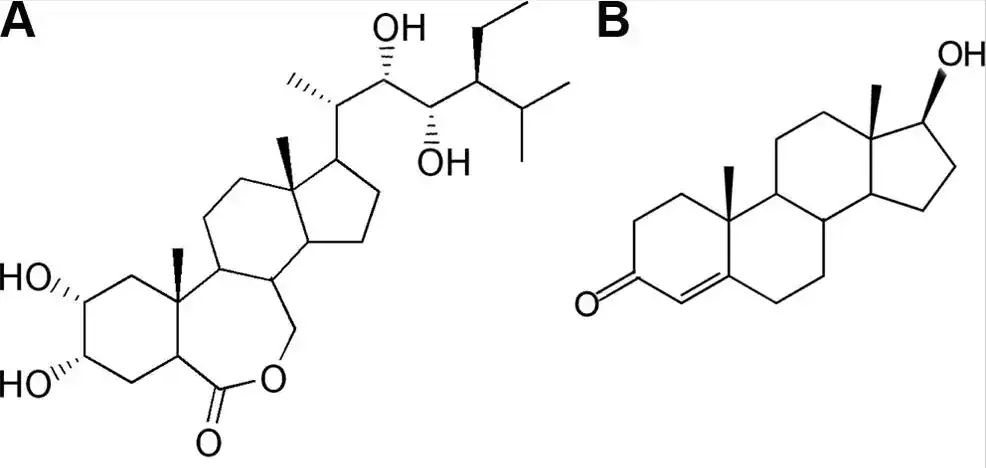
They even have a similar cholesterol-like structure. “Brassinosteroids are plant-derived polyhydroxylated derivatives of 5a-cholestane, structurally similar to cholesterol-derived animal steroid hormones and insect ecdysteroids,” as some research put it.
Here is a picture to show the similarities. A is one brassinosteroid, HB (discussed more below), while B is testosterone.
Anabolic Effects of Plant Brassinosteroids
A specific brassinosteroid, 28-homobrassinolide (HB), was given to rats. Over the course of 24 days, these rats:
- Ate more food.
- Gained more weight, specifically lean muscle mass.
- Had larger leg muscles (gastrocnemius muscle).
- Muscle Fiber Changes: In rats that had their testes removed (to eliminate natural testosterone), HB still promoted muscle growth, increasing both the number and size of certain muscle fibers.
- Showed improved physical strength, with a 6.7% increase in grip strength.
- Minimal Side Effects: Unlike anabolic steroids, HB did not show significant male hormone-like side effects. It didn’t bind to androgen receptors, which are typically involved in such side effects. (The researchers said it had anabolic but not androgenic effects.)
HB has been shown to increase protein synthesis in plants. This was in response to heat shock, showing the adaptogenic potential of these compounds regardless of plant or animal kingdom.
Another mouse study found “increases in treadmill performance and enhanced grip strength were observed with HB”.
Someone even filed a patent for “Brassinosteroids for use in treating prostatic hyperplasia and androgenic alopecia”, though unfortunately, there’s not much more information on that available.
Brassinosteroid Benefits Outside of Hormones
Some additional effects have been investigated, as these two summaries have shown.
Understand that while these findings are promising, most studies have been conducted in laboratory settings. Further research, including clinical trials, is necessary to fully understand the therapeutic potential and safety of BRs in humans.
Anticancer Effects
BRs have shown promise in laboratory studies for inhibiting the growth of various cancer cells, including breast, prostate, and colon cancers. Several of the tested BRs were found to have high cytotoxic activity. They can induce programmed cell death (apoptosis) in these cells without harming normal cells.
Certain BRs have demonstrated the ability to inhibit the replication of viruses such as herpes simplex virus type 1 (HSV-1), polio, measles, Junin, and vesicular stomatitis virus (VSV) in cell cultures.
Antibacterial and Antifungal Activity
BRs play a vital function in inducing disease resistance in plants. So it should come as no surprise that they exhibit antimicrobial properties, effectively reducing the growth of certain bacteria and fungi.
Anti-Inflammatory Effects
BRs show strong anti-inflammatory potential by suppressing the production of pro-inflammatory molecules like TNF-α, IL-6, and nitric oxide—compounds typically elevated during inflammation. They also modulate signaling pathways such as NF-κB and MAPK, which play key roles in triggering and sustaining inflammatory responses.
Wound Healing
BRs have been observed to promote skin regeneration and wound healing by modulating inflammatory responses and encouraging the growth of new skin cells.
Anticholesterolemic Action
In animal studies, rats given a type of BR called 24-EpiBL showed significant drops in cholesterol and triglycerides—even when they were fed a high-cholesterol diet. Depending on the dose, total cholesterol dropped by up to 44%, and triglycerides fell by as much as 68%. The rats also showed increased levels of beneficial vitamins like vitamin E and A.
Neuroprotective
A specific brassinosteroid, 24-Epibrassinolide, exerted antioxidative and neuroprotective actions in mammalian neural cells, specifically the dopaminergic neurons.
Detoxifying Pesticides and Heavy Metals
Brassinosteroids play an important role in helping a plant to detoxify or metabolize pesticides.
Researchers found that applying BRs externally to plants like tomatoes, rice, tea, broccoli, cucumbers, and strawberries reduced residues of common pesticides—such as organophosphorus, organochlorine, and carbamate compounds—by 30–70%.
Plants also use glutathione, which is considered the master antioxidant in humans, and this has been shown to increase with application of additional brassinosteroids. There was also upregulation of detoxifying enzymes like cytochrome P450.
Similarly, the BRs have been shown to make plants more resistant to heavy metals in the environment.
Considering many pesticides are endocrine-disrupting chemicals, might brassinosteroids in us help to protect and detoxify the same?
Might brassinosteroids help us to handle and detoxify heavy metals as well?
Conclusion
While brassinosteroids are best known as plant growth hormones, the research explored here paints a compelling picture of how these compounds can help us. Found richly in Pine Pollen, brassinosteroids may not only support muscle growth and hormonal balance but also display promising antiviral, anti-inflammatory, antioxidant, and detoxification properties.
Their structural similarity to human steroid hormones, along with their wide-ranging physiological effects, shows how these can give adaptogenic effects.
Stay tuned for a similar deep dive on another major class of phytoandrogens, gibberellins, coming soon.

“BRs show strong anti-inflammatory potential by suppressing the production of pro-inflammatory molecules like TNF-α, IL-6, and nitric oxide…”
Why would we want to ingest anything that suppresses the production of nitric oxide? Isn’t NO fundamentally important to our health?
Yes and no. Like all things the right amount in the right places is key like for cardiovascular and sexual health. That being said NO is inflammatory. Therefore modulation may be more important than strictly boosting it.
Fascinating info!
I thought so too.