Last updated on October 8, 2025
One of the most common questions about herbal tinctures is: How long do they last? Do they actually go bad? Is there an expiration date?
The truth is simple: tinctures made with 30% or higher alcohol (what we use at Lost Empire Herbs is typically 40-50%) almost never spoil.
The alcohol content keeps bacteria, mold, and yeast from growing. So, in that sense, in almost all cases, they do not expire. They do not go bad. (In the thousands of tinctures I’ve personally handled, and the tens of thousands we’ve sold, there’s been mold in maybe ten or less.)
That being said, there is a gradual decline in potency as active plant compounds naturally break down, even with proper storage. In this article, we’ll dive into the ins and outs of this issue, including what science shows.
Spoilage vs. Potency Loss
When people talk about tinctures “going bad,” they may mean one of two things:
- Spoilage (microbial growth): Only an issue for low-alcohol, vinegar, or glycerin tinctures. Rarely happens with alcohol ≥30%. 20% is probably enough, but it is cutting it close at this point..
- Potency loss (chemical degradation): Happens in all tinctures. Herbal compounds weaken over time, but the tincture remains safe.
For alcohol-based tinctures, the issue almost always isn’t safety, but instead is about effectiveness.
Why Alcohol Percentage Matters
Alcohol acts as both a solvent (extracts plant compounds) and a preservative (prevents spoilage).
- High alcohol tinctures (70–95%): Strongest preservation, longest shelf life. For some herbs may be best to get the most compounds out.
- Standard tinctures (30–60%): Fully protected against spoilage, though some compounds degrade faster.
- Low alcohol (<30%): Shorter lifespan with greater risk of microbial spoilage.
- Glycerin or vinegar tinctures: Even shorter lifespan than low alcohol. Generally, only good for up to 6 months, maybe 1 year at maximum.
In addition to its superior solvent properties, this is why most professional tinctures are formulated at or above 30% alcohol.
Science-Based Data on How Long Do Alcohol Tinctures Last?
This issue of shelf life has been looked at scientifically. Here is an overview of everything study-wise I could find relevant to the issue at hand. Please note that, as you’ll see, each herb works a bit differently.
Cannabis Tinctures
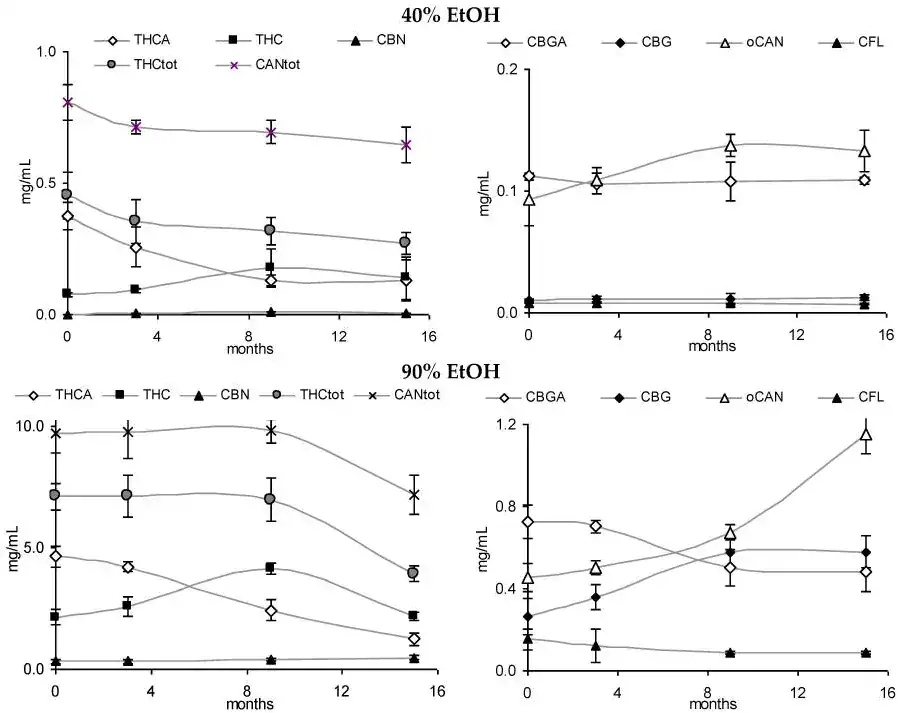
This study looked at THC, CBG, and other compounds inside tinctures of Cannabis. This compared low and higher alcohol tinctures, as well as those stored at room temperature, compared to those in the fridge.
- High alcohol tinctures (80%–90% EtOH) contained ten-fold more cannabinoids than tinctures (40% EtOH). This means that higher alcohol was more useful for extracting cannabinoids in the first place than lower alcohol.
- Stored in the refrigerator, tinctures lost ≤10% of total cannabinoids after 9 months.
- THCA naturally converted into THC over time, but much slower in the fridge (15 months) vs. room temperature (3 months).
- As you can see in the chart below, sometimes compounds increase over some span of time, but then can drop back down. Take a look at the bottom left of the 90% EtOH tincture, where THC increases up to the 9 month point, then drops back down to basically its same 0-month position at 15 months.
Western Herbal Tinctures (Chelidonium, Sambucus, Thyme)
This study looked at a few different herbs over a period of just six months. Some dropped off rather quickly.
- Elderberry tinctures (25% alcohol) stayed stable for 6 months before compounds fell >10%.
- Chelidonium and Thyme tinctures (each 45% alcohol) lost >10% in just 1.5 months.
- This study didn’t look at any herbal tinctures longer than 6 months.
Lamiaceae Family (Rosmarinic Acid Stability)
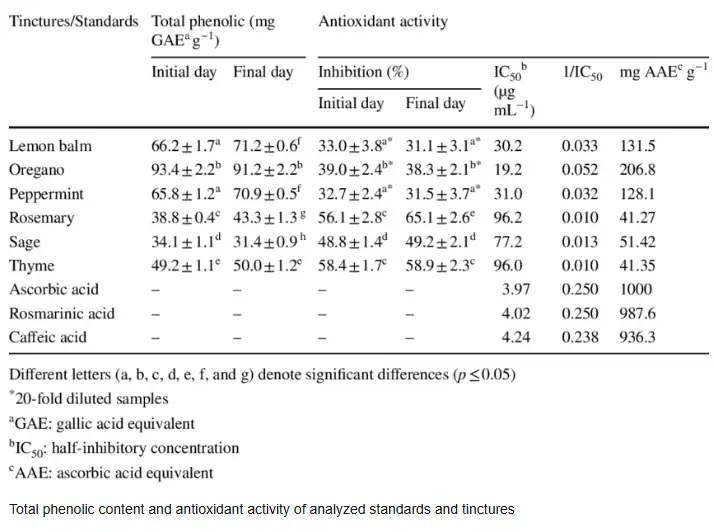
- In herbs like Oregano, Peppermint, Rosemary, Thyme, Lemon Balm, and Sage, rosmarinic acid declined gradually stored in closed amber glasses at ambient temperature.
- After about 168 days (5-6 months), most tinctures showed <10% drop in rosmarinic acid, which had converted to caffeic acid.
- While that single marker compound decreased, in some cases, total phenolic content and antioxidant value increased over that time span.
More with Peppermint, Sage & Thyme Tinctures
For whatever reason, looking at some of these herbs seems to be popular for this sort of testing. This study looked at several different herbs as well as alcohol percentage levels, and was also the longest-running of the studies discussed here.
- The antioxidants were more stable in alcohol-and-water tinctures than in water-only syrups, backing the idea that alcohol protects the good compounds longer.
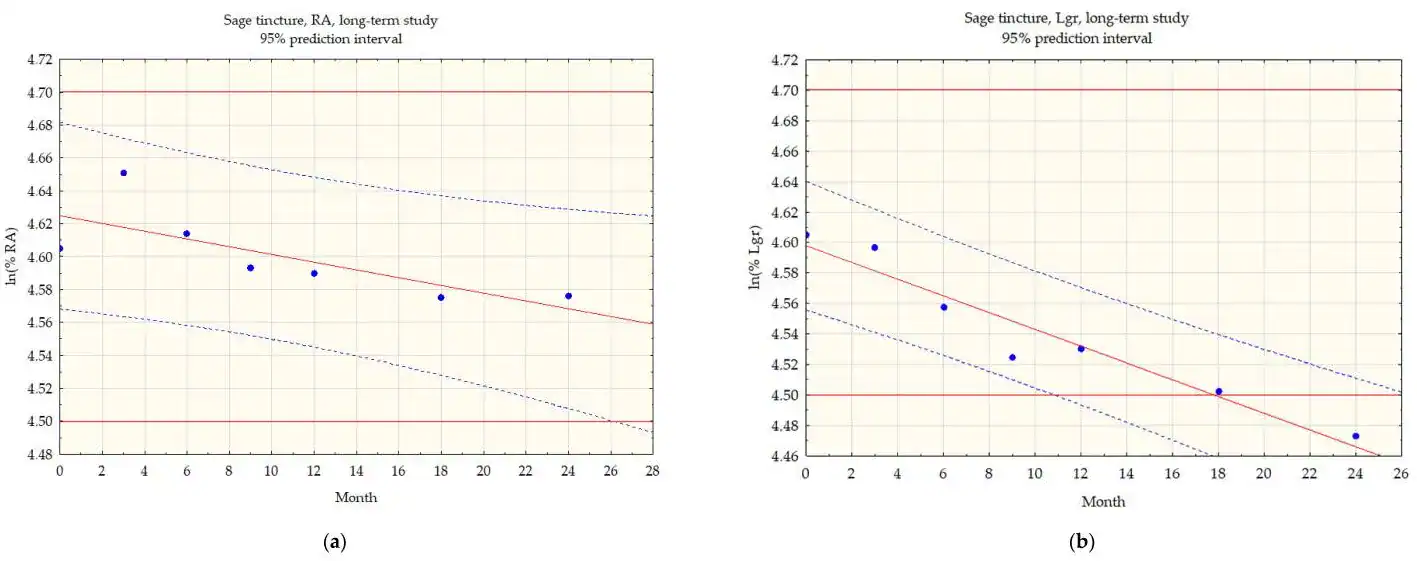
- Sage tincture (60-70% alcohol): One major antioxidant stayed close to its starting level for about ~26 months, while another, more delicate one held for roughly ~11 months.
- Sage + Thyme spray (~40% alcohol): About ~22–28 months, depending on the compound measured.
- Peppermint tincture (80-85% alcohol): One lot held up around ~10 months, another closer to ~16–21 months for the compounds tracked. This means that there is variation from batch to batch, even if they’re prepared much the same way.
- Thyme syrup (<6% alcohol): Looked okay until ~18 months, then one key compound dropped sharply by ~24 months.
- Again, notice that while the compounds typically go down, there are months where an exception to this rule takes place. In the chart on the left for the Sage tincture, the compound is higher at 3 and 6 months than it is at 0 or 9 and beyond.
My Thoughts About 10% Drops
The 10% loss rule is a well-accepted practical benchmark in accelerated stability testing and shelf life estimation. I understand they have to draw a line somewhere, but that means there was 90% of the compound still available.
While that certainly matters if you’re guaranteeing a certain amount of something, this points to the herb still maintaining plenty of potency.
Most of these studies didn’t go too long. At best, we had a bit over two years. But this raises the question, what is potency at 3 years out, at 5 years? Are we talking 50% or 10%?
What is also really intriguing to me is the increases seen in compounds, total phenols, and antioxidant value in some of the research. Sure, rosmarinic acid went down, but that really only looks at one molecule out of many. That was after 168 days. Would that trend continue? Does it reverse at some point?
And all of this pertains to just a few herbs. I think there is enough similarity that this likely applies to most herbs. But I would certainly like to see this kind of stability testing shown across a wider range of plants. (And what about animals and fungi too? Could there be important differences as well?)
Best Practices for Storing Tinctures
- Keep in amber glass bottles to block light. Miron glass is even better, though significantly more expensive.
- Store in a cool, dark place.
- Refrigeration is not necessary, but according to the cannabis data, it does extend life.
- Seal tightly to prevent oxidation.
- Keep droppers clean (don’t touch tongue/skin).
- Aim to use within 2–3 years for best potency. Quicker is likely better.
Conclusion: No Expiration, Just Potency Decline
Alcohol tinctures don’t expire the way perishable foods do. At 30% or higher, spoilage is virtually impossible. We have seen a couple of tinctures over the years sporting what appears to be mold growth. But this is extremely rare.
Instead, the data seems to indicate that tinctures gradually lose effectiveness as herbal compounds break down over years. However, some compounds may increase.
In alchemy, a 95% alcohol tincture is said to get better with time. Maybe someday in the future, we can test a 10-year-old tincture vs a brand new one and judge that claim. But even then, we’d likely only be looking at one or two compounds, not the hundreds that could be in there.
All this to say, think of tinctures as having a “best potency window” rather than a hard expiration date. With proper alcohol levels and storage, they remain safe and effective for years.
For all these reasons, our tinctures do not sport an expiration date.
FAQ: Tincture Shelf Life
Do tinctures expire?
Not in the spoilage sense if made with ≥30% alcohol. They simply lose potency over time.
How long do tinctures last?
High-alcohol tinctures (70–95%) can last 3–5 years or more. Standard tinctures (40–60%) stay potent for 2–3 years.
Can tinctures grow mold?
Only if the alcohol content is too low (<30%) or if they’re contaminated. At 40% or higher, this is almost impossible.
Should tinctures be refrigerated?
Not required, but refrigeration does appear to slow down chemical degradation and can extend potency.
How do vinegar tinctures or glycerin tinctures compare?
These have a shorter shelf life of six months, at most one year. They should be refrigerated or used quickly.